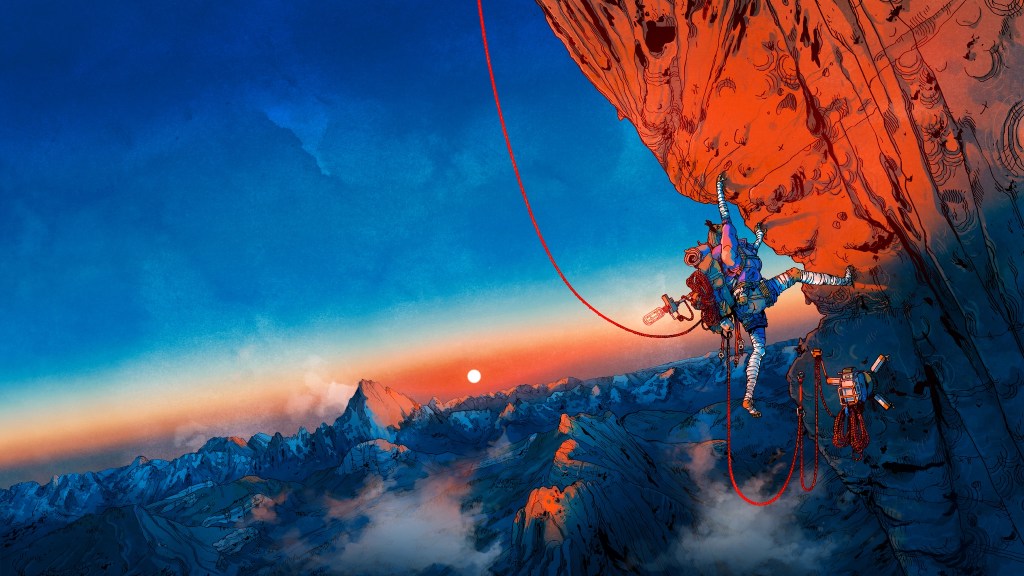
Cairn is a video game about climbing a mountain. The protagonist is an accomplished climber named Aava who has been climbing since she was a toddler. She was pushed into this life by her climber father. It is all she knows. In a conversation late in the game she states, “I was born on this mountain. There was nothing before it, and there will be nothing after. There’s only the mountain.”
Cairn follows Aava’s ascent up the fictional mountain Kami. We are constantly reminded that Kami is a notoriously difficult mountain to climb. Nobody has done it before. Everybody else has either died or turned back. Aava has accomplished everything else she could. Summiting Kami is the only thing left.
The game opens with Aava saying that the reason she climbs is “to reach one of those rare moments of bliss, where everything seems in its place, and you feel you’re part of a whole.” This is a very romantic idea about transcending your body and feeling at one with nature. It is very peaceful. And it does not track with Aava’s character at all.
Aava is angry. For many players, they probably first notice this the first time they fall from a moderate height and Aava screams in rage or yells “fuck” seven times in quick succession. That’s not the reaction of a person who is at one with the mountain. It’s the reaction of a person who is in conflict with the mountain. Despite what she sometimes says, there is very little actual transcendence for Aava throughout her climb. Cairn successfully presents it as a difficult and sometimes tedious process and as an obstacle that exists to be conquered.
On her ascent, Aava eventually meets a younger climber named Marco. Marco is the opposite of Aava. He is unbearably chipper, and he serves as a foil to Aava’s ideas about climbing. Aava is doing this to reach the top, so she can prove something to herself. She is obsessed with achieving this goal and will do so at the cost of her body and her personal relationships. Marco, on the other hand, already knows he won’t reach the top. He plans on going as far as he can, enjoying the view, and heading back down. Aava is disgusted when she hears him say this. She can’t understand why someone would accept failure.
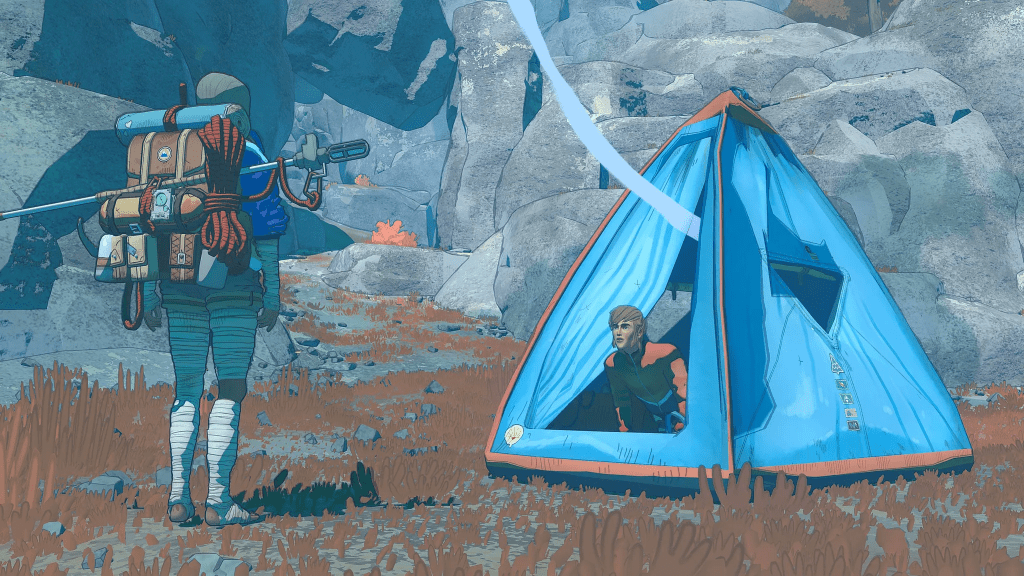
The thing that Aava doesn’t want to say among all her talk about becoming one with the mountain and surpassing her limitations, is that climbing is also a form of avoidance for her. We hear a few voicemails sent to Aava’s climbing robot from her partner Naomi. The first two of these are simple well wishes, but the latter two detail their cat being sick and ultimately having to be put down. Aava responds to these messages with rage, after the second one ripping the antenna off the bot and tossing it off the mountain so she can’t receive more messages. This is incredibly upsetting news to receive. Her reaction is understandable. But Aava’s not angry at the circumstances. She is angry at herself. She is angry that Naomi is making her feel guilty by sending these messages. In the final message Naomi asks why she is doing this. After Aava throws the antenna she says that Naomi could never understand. Aava finds meaning in the physical challenge of climbing the mountain, but it also is easier than dealing with the emotional challenge of repairing her relationship.
The writing and the performances in Cairn are not subtle. It can all feel pretty cliche at times, and there are some odd inconsistencies or sudden swings in characterization that feel forced. I don’t think it’s a very well-written game. But it also doesn’t forefront its writing. Cairn is primarily about climbing a mountain. Mastering the control scheme, learning the rules of the physics, and envisioning routes up cliff faces is the main draw, alongside the breathtaking sights. Aava’s emotional journey is woven into this well enough, and the game does successfully (if a little hamfistedly) set up its clear thematic center with Aava and Marco representing competing ideas about why we do difficult things. Marco represents joy in experience while Aava represents meaning in achievement.
This all builds to a moment of player choice. Aava and Marco eventually get close to the summit and meet a legendary climber named Damas who has been living here for over a decade. Damas tells them that they should go home. Everybody who he has seen try to continue the climb from this point has died. Marco is going to go back down, and as Aava you have the choice to join him or continue to the summit. Aava and Marco make their final pitches to each other. Marco tells Aava, “the mountain is all in your head. Like a disease that’s eating at you. You can heal if you want to.” Aava responds, “things are so easy here. The goal is clear. It’s a climb that’s entirely up to me. Exactly what I can’t have in life down below.”
This is what the choice comes down to. Will you heal yourself and become a fuller person or continue to focus on something you can control at the expense of your well-being? How far will you take your obsessions? How much will you push yourself? These are questions that have been asked many times by many works of art, and I find them very resonant. Hyper-focusing on achieving goals as a way to avoid more uncomfortable problems is a common experience, even if the results aren’t often this extreme. I like the idea to challenge players with this choice. Gaming is often an achievement-oriented medium, and this forces the players to confront that orientation. Will you give up on the final boss so you can fix things with your girlfriend?
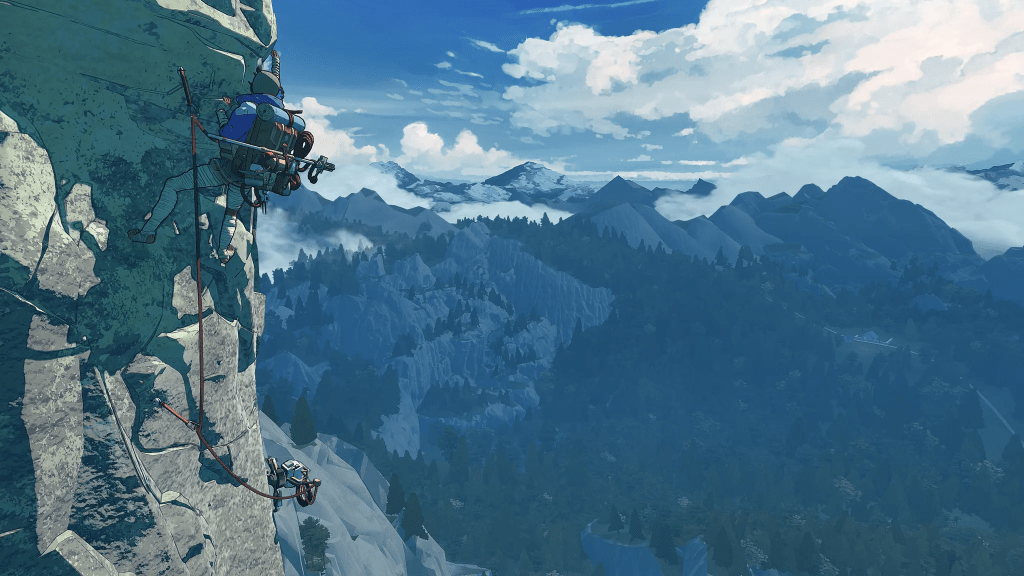
So I chose to keep climbing. I don’t know why. Maybe Marco was just a little too annoying. Maybe I found Aava’s angst a little too unbelievable and didn’t care enough about her as a character. Maybe I was just enjoying the climbing too much and didn’t want to end the game. Whatever the reason, I kept climbing. Looking at the achievement data on Steam, so did about 80% of the people who completed the game.
I don’t think that is necessarily a sign that the game failed, even if the game is thematically building to Aava coming down. ‘Gamers’ are going to make the decision that gives them more ‘content.’ What I find interesting about Cairn is that after summiing Kami I feel completely vindicated in my decision. The final climb to the summit is the best stuff in Cairn. It is undeniably the right choice.
If you choose to go back down with Marco, they exchange some words about how it’s time to turn back, hug, and slowly repel out of frame. It is a very short and quaint ending. The hard work of rebuilding Aava’s life will have to happen off-screen.
If you choose to keep climbing, you first talk to Damas again. He makes you look at bodies of dead climbers dangling from the ropes caught on pieces of ice. He even makes you shoot one down. It’s a more effective deterrent than anything else up to this point. It instills a real sense of fear and also shows the indignity that a death on the mountain would truly result in. If this was before the point of no return, maybe I’d go the other way. But it’s too late.
The final summit starts with a climb that is somewhat challenging but not unmanageable. Then there is an avalanche on the mountain, and you need to pick up the pace. The surfaces you’re climbing are falling apart. Wind and snow are obscuring your view. It’s very exhilarating, enhanced by intense music that uses Aava’s breath as the beat.
Once you are through the avalanche, the challenging climbing is mostly done. But now Aava has to trudge through thick snow between every section of the mountain. Supplies disappear and you start to use everything in your backpack. In addition to managing your thirst and hunger like you have for the whole game, the cold is now also a factor. If you don’t find ways to keep warm you will freeze to death. Aava starts to hallucinate and for the first time doubts her own ability to keep going. The peak is within sight, yet it feels so far away still. Progress is so slow. Everything is dark. You feel the adrenaline push of “I just need to get there.”
This is the most effective the game ever is, and it is communicated almost entirely through visuals, sound, and game mechanics. Cairn is hardest in the first few hours when you are trying to learn the mechanics of the game. Once you’ve mastered those, the climbs start to feel more relaxing than anything. The final section upends that. It brings the tension back and makes you really believe that nobody has survived this climb before.
Then, after trudging through all of this snow, when it feels like there’s always going to be another climb, you finally reach the top. Your backpack is depleted. Your robot has stopped working. Aava lets out a final set of screams and collapses to her knees. Then you are given a button prompt. “Be part of a whole.” The game has come full circle. Aava has reached her goal stated in the game’s opening. You press it, and then you start climbing the stars, eventually catapulting Aava triumphantly into the heavens.
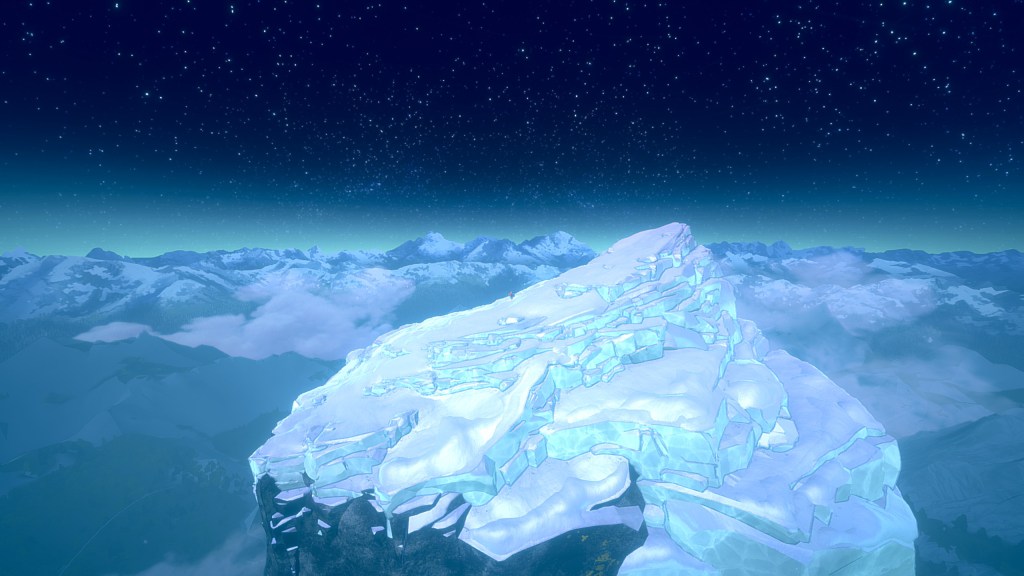
The game is ambiguous about what happens, but I can’t help but read it as Aava dying. She is spent of all energy and resources by the time she reaches the top. I do not know how she would get down. Nobody is coming to rescue her. She has achieved her goal. She has practically killed herself to achieve it. And by doing this, she has ascended above the Earth. She has become one with the mountain and will never have to deal with the pain and disappointments of life again.
In the last hour of Cairn (and of Aava’s life) both player and character experience thrill, beauty, fear, struggle, and ultimately transcendence. It’s not clear that any emotional experience on this level is on offer for Aava if she goes back down the mountain. In the moment of the game’s big choice, the ultimate question Cairn is asking is how far would you push yourself in order to achieve your goals. The clear answer Cairn gives is that you should push yourself all the way.

