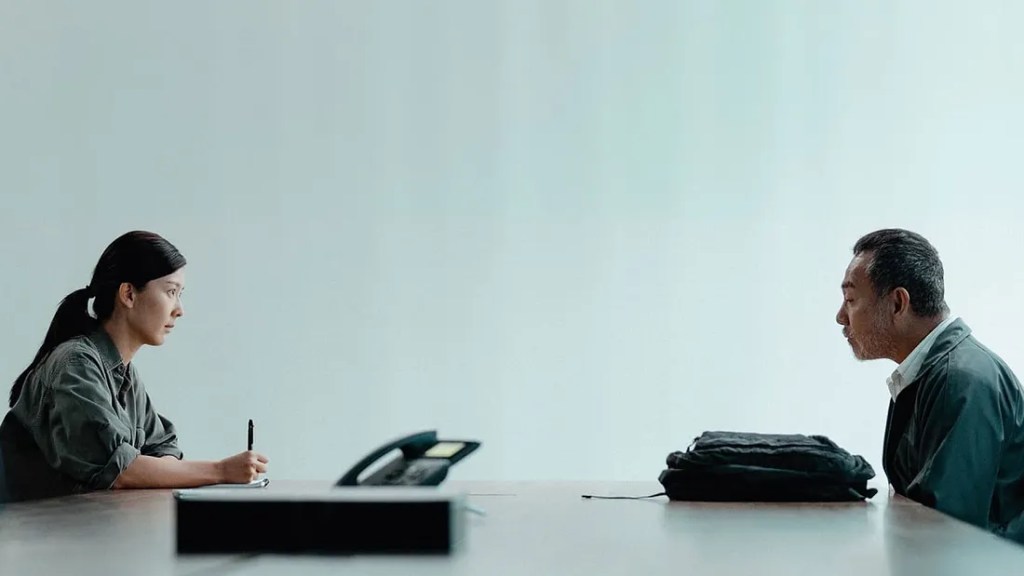
This review was originally posted on Medium on February 23, 2024.
I recently (as of the time I started writing this) saw In Broad Daylight, a Hong Kong film released late last year directed by Lawrence Kwan. This film could easily be categorized and perhaps dismissed as a simple issue movie, a film that dramatizes a problem in society in order to draw attention to injustice and perhaps spur the audience to action. The film even ends with somewhat of a call-to-action, with text on the screen stating how the problems on display in the film are not confined to the real-life story from eight years ago that the film’s plot is based on. Going in, I was worried that the film would be overly didactic and not willing to engage with the topic on a particularly deep level aside from saying that this horrible thing was horrible. And while there are certain elements that feel like they could turn that way, the film thankfully has a deeper understanding of the complexity of both the social issue at hand and the emotional lives of those involved.
The issue at hand in this case is the mistreatment of the elderly and disabled in Hong Kong society, and specifically in the private “care home” industry. The waiting times in Hong Kong for public care homes are prohibitively long, and so many people with loved ones they don’t have the ability to care for (or whom they don’t want to care for) send them to private homes instead, where abuse is rampant and oversight is practically non-existent. The film follows an investigative reporter, Kay, who goes undercover as the granddaughter of a resident at Rainbow Bridge Care Home and discovers a string of cruelties from general poor conditions to physical and sexual abuse committed by the head nurse and warden respectively.
The abuse that the residents suffer is undeniably horrific, and the movie makes no effort to shy away from that fact. Both the nurse and the warden are uncomplicated villains of the film, almost cartoonishly so, especially in the case of the nurse, who is so robotically cruel from the minute the film starts, that it becomes a little difficult to take her seriously. This is less of an issue with the character of the warden, who is somewhat charismatic and has built trust with the people he abuses. I think it’s noteworthy that the resident who commits suicide in the film is faced with the most physical abuse we see from the nurse but only takes his own life when the warden is assaulting one of his friends. Not only does this show the care and emotional connection between the residents, but it also shows how deeply the betrayal of trust committed by the warden is felt.
But even with that added element, the film runs a risk of ending its investigation of care homes at it being horrible and indefensible that these people commit this abuse. Everyone watching and everyone who hears about this real-life story would agree that the cruelty these people commit is undeniably bad and needs to be stopped, condemned, and likely punished in some way. Very few people fundamentally believe that this sort of abuse is good, which begs a larger and more complicated question: If everyone agrees that this is wrong, why does it happen, not just in this one case, but on a society-wide scale?
This is the question that In Broad Daylight is most interested in answering and that Kay stumbles into as a result of her investigation, because this is ultimately not a film about these two horrible people or even about abuse at care homes. This is a film about the ways society (and specifically the capital-oriented society of Hong Kong) views people who do not serve any economic use. A word that gets used many times in this film to describe the residents of the home is “burden”. The people being abused in the care center are an economic burden on society in the most literal sense. They cannot produce economic value of their own through labor, and yet they still require resources to care for. And in a world where everything’s worth is measured by the value it creates, being a burden is the worst thing you can be.
And that is ultimately the answer to why this can happen. There is a contradiction between our belief that cruelty is wrong and our belief that humans must produce economic value, beliefs that most people in modern society hold to some degree, because limiting cruelty also limits production. Lots of cruelty is enacted every day, and we’ve built vast ideological systems that help us compartmentalize and forget about it or even justify it as serving some greater cause. The film shows in many different ways that acknowledging the problem creates a lot more questions about how we care for each other that are easier to simply ignore.
Some of the scenes in the movie that reveal this the most are those featuring the often absent family members of the residents. There are not a lot of these scenes (which itself helps drive home to point of these “burdens” being intentionally forgotten), but the ones that are there are interestingly diverse, ranging from people outright rejecting the idea of seeing their family member again to regret and guilt upon learning about the abuse to more resigned hopelessness at the whole situation.
One of the scenes that has stuck with me the most is when the mother of Siu-Ling, one of the mentally disabled residents who is abused by the warden, learns the extent of the abuse and opens up about how she regrets not taking care of Siu-Ling herself. It’s an emotional scene, but the unspoken truth is that she probably would not have been able to. The reason Siu-Ling was in the home in the first place is not because her mother was careless or genuinely thought their care would be best. The reason is that care requires money. Her mother needed to work in order to support her, and she couldn’t both work and look after her daughter full-time. Putting her in the home was the only viable economic decision. She had to work in order to earn money so that she could continue to pay people to look after her daughter, only for those people to abuse Siu-Ling. It is a heartbreakingly hopeless and bleak scenario that lays bare the utter depravity of a society that has determined this as the only solution to this problem.
Siu-Ling’s mother dedicating her life to caring for her daughter would very clearly be a meaningful endeavor on a human level. There is not much more meaningful we can do than care for each other. Yet, it would also be a life that provides no economic value. Her working a job that produces some sort of value and then turning around and paying money to a care home that itself contributes to the economy keeps the gears turning. Her being given financial support to care for her daughter would simply turn both of them into burdens. In the real-life scenario, Siu-Ling even stops being a burden on some level as her care becomes a commodity and therefore contributes to the economy. It’s bleak, but it fits with how the system is supposed to work. Therefore, we allow it to continue no matter how barbaric it is by simply pretending not to see the barbarism.
In addition to being a movie about abuse in care homes, In Broad Daylight is also a film about journalism. The main character is an undercover investigative reporter trying to break the story of what’s happening in the care home. In many stories like this, the journalists in this story would be unambiguous heroes trying to wield the power of the press as a bludgeon against injustice. But while it does have a very hopeful undertone, In Broad Daylight’s vision of journalism is not free of cynicism.
Early on in the film, before she becomes more personally invested in the story, Kay’s focus is on how this story can help her career. She is an already award-winning journalist, and she views this story as her next big shot at more acclaim. It is very easy to see this attitude and find it an indictment of Kay’s self-aggrandizing behavior, but it’s more a matter of survival than a character flaw. It seems like every week that I’ve failed to finish this review since mid-November, another media outlet has shut down or experienced mass layoffs; we are living in a socioeconomic environment that is actively hostile to the work of journalists. While what Kay does has obvious benefits to society in exposing injustice, to a for-profit media outlet the stories she covers have little to no economic value if they fail to bring prestige, attention, and, indirectly, money, to the outlet that publishes it. This is work that takes a lot of time and resources before it provides any value, has no guarantee of success, and comes with risks of reprisal. If the piece is unsuccessful in drawing eyes to her publisher, her career becomes a bad investment. Similar to the situation with Siu-Ling’s mother, journalists (at their best) provide an undeniable social value to society. However, their ability to provide economic value is more of an open question, and oftentimes the most economically valuable journalism is also the most societally damaging. Good journalism becomes another economic burden in a dysfunctional society.
This cynical view of modern journalism fits naturally next to the bleak situation at the care home. But it is also through the lens of reporting that In Broad Daylight moves beyond the difficult-to-watch bleakness and begins to emphasize a vision of hope. When Kay leaves the paper she works for late in the film, she gives a speech about how people will always be looking to spread the truth regardless of the institutional future of the press. This speech carries some of the blind naivete that is characteristic of a lot of movies about investigative reporters. The idea that someone with a camera, a microphone, and a notepad can challenge power and injustice is true, but the effect of that effort is often vanishingly small. However, In Broad Daylight is aware of these limits as the main perpetrators are never held accountable and the larger structural issues are nowhere close to being resolved. In fact, by the end of the film it’s unclear if anyone is better off as a result of Kay’s work. The story gets run, the truth gets revealed, and things are not fixed. And it’s this awareness that makes it clear that Kay’s hopefulness is not as a result of her belief in the undeniable power of the fourth estate, but of her growing belief in the emotional connections she forms with the care home’s residents.
Something that separates In Broad Daylight from a lot of other journalism films is that it isn’t a movie about hero journalists who break a story and save the day. This is a result of the way the film cares about the residents. A comparison that came to mind while watching In Broad Daylight was Spotlight, the 2015 film about Boston Globe reporters uncovering rampant sexual abuse within the Catholic Church. That film portrays the victims sympathetically and gives them a chance to speak their pain to a reporter, but it ends there. They are ultimately a means to further the story of our real subjects, the journalists. They are sources and victims, but they aren’t fully realized people.
In Broad Daylight goes much further with the way it represents the residents, to the point where many of them get more screen time than any of the reporters aside from Kay and leave a much larger impact on the viewer. We get to know them as people and see their moments of joy and camaraderie in addition to the harm that is inflicted upon them. They are people with complexity. Instead of being helpless victims waiting for Kay to save them, they fight back against and deceive the home’s staff. They work with Kay but also treat her with skepticism until she has earned their trust. Some of them even disagree with Kay’s mission and see their alternative as worse than their current state, a position that is potentially justified by the film’s somewhat ambiguous ending. In Broad Daylight views the residents as people first and as victims second. A big topic in the film is about the indignity that the people in the home are subjected to, and in showing the fullness of their emotional experiences and making that the thing that fuels Kay’s continued motivation, it feels as though it’s attempting to provide them with that dignity and with a voice that a society so focused on their economic burden simply won’t.
 Nonlinear Perspectives