
Films about dreams often have big, surreal images, unbelievable breaks in reality, surprises, moments that make you go “wow.” But as somebody who has dreamed before, I don’t often think of my dreams as having those things. For me dreams are instead a half-remembered series of images that feel as real as can be in the moment but fall apart upon further reflection. In that sense Bi Gan’s Resurrection might be more true to the experience of dreaming than a film like Paprika or Inception. Dreams in this film are not wild flights of fancy. They are reality but slightly askew and hard to grasp.
A great example of this can be seen in one of the film’s sections (Resurrection is split into distinct short stories representing different dreams and eras) where the setting blurs between a train station, a boarding house, an orphanage, a mental hospital, and a villa. When the characters are looking at the orphanage above the lobby of the train station, it doesn’t feel weird, largely because it isn’t called out verbally or lingered on in the filmmaking. It just looks like those rooms would be there. The movie is full of images and moments that are impossible but do not feel that way when watching them.
The effectiveness with which it captures this dreamlike feeling also makes Resurrection a bit of a difficult film to talk about. I have seen it once in a movie theater, and while it is a movie that sticks with you, it is also a movie where it is hard to take in and analyze every detail because of its loose sense of reality.
The reason I bring this up is to acknowledge that there may be things that I somewhat misremember. There are certainly things that I have forgotten or didn’t quite catch in the moment. The close analysis is going to have to wait until the film is in a format where it can be paused, rewound, and watched a million times. All I can do now is try to discuss the broad ideas, the feelings, and the overall motion of the film. And in the spirit of a film that says some direct version of “films are a form of dream,” I will be direct in saying it is maybe fitting to analyze this film in this way. Reading this piece might feel like listening to someone talk about their dreams. Take that as a warning if you wish.
Resurrection is textually about dreams. The film starts as a silent film with title cards that tell us this is a world where people have learned that the key to eternal life is to not dream, but some people have decided to still dream in spite of this. Those people are called deliriants, and film is a type of deliriant. We soon meet one of these deliriants, a monster with an opium addiction, who is captured and taken to be treated by a woman who starts the treatment by placing a film reel in his back. Then we spend the rest of the film moving through the deliriant’s dreams.
Right away there is this notion that people do not dream anymore. Dreaming is a sort of rebellion against the norms of a society focused on the present, and through creating or engaging with art we can still dream, imagine something different, and care about something other than what the stresses of modern life tell us to focus on.
The film ends with shining silhouettes of people sitting in a movie theater as the camera pans out and shows a world burning down around them. There is something undeniably self congratulatory about all of this. You, the person who chooses to spend 2 hours and twenty minutes in a dark theater giving yourself over to somebody else’s vision in a world where we are engaged in an ever-lasting present, with instant communication technologies, endless distractions, and a capitalist society that values productivity above all else, you are a dreamer. You are a delirious deviant who dares to dream. Watching movies makes you special.
If I heard a person tell me this, I would think it is a bunch of cloying nonsense. I do not begrudge anybody who leaves this movie feeling that way. I think it’s a reasonable reaction. But that is only the beginning and end of Resurrection, and it is in the middle, in the dreams themselves, where the film reveals itself and its understanding of dreams to be a lot more complex than that.
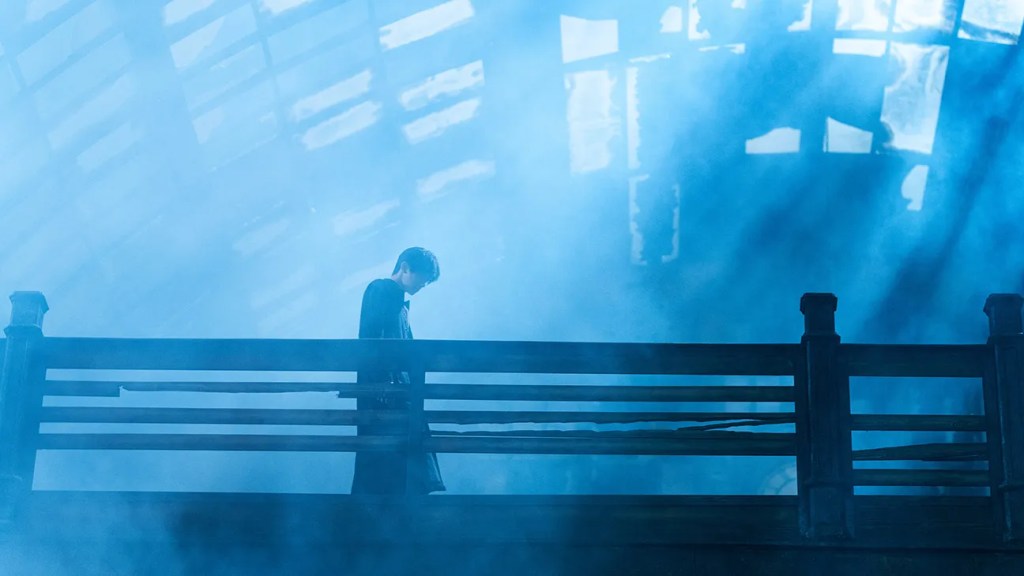
For reference, the dreams themselves are as follows. The first one is a World War II era noir with a hard to follow plot in which the protagonist is being interrogated under suspicion of murder. The second one is a story about a former monk who returns to his old temple with a group of thieves and has an argument with a spirit that was trapped in his tooth. The third one (set in the previously mentioned train station, orphanage, etc.) is about a conman who teams up with a child to do magic tricks in order to impress an eccentric millionaire. The fourth one is about a man on New Year’s Eve 1999 who falls in love with a vampire in a town run by a vampire mafia.
Dreaming itself works its way literally into a lot of these stories, as if the dreamer subconsciously knows he is dreaming. The first dream starts with a character waking up. The second one involves a character hearing a voice in his sleep. Not only are there literal dreams, but there is also an examination of the other ways we try to imagine a different reality. There are musicians and magicians. There is a discussion of faith. There is a person hoping the new millennium will bring something different. These are all ways that we imagine, ways that we believe in something more than what is right in front of us.
One of them is another art form just like film. The others are all ways in which we trick ourselves. We believe in these things in order to imagine something better. We want magic or gods to be real because it would be better if they were. We want to believe that the turning of a new year changes something about us because we don’t like what we currently are. And maybe the art forms are alongside these others for a reason. Maybe they are also tricks. Maybe they are just other ways humans are hopelessly grasping for something more. In the third dream, the conman tells the child that she needs to believe she is doing magic in order to do it effectively. Maybe when a filmmaker makes a film, or when we sit down to watch it, we need to believe we are doing more than looking at pictures on a screen because it is what we believe that ultimately creates meaning.
There is also a feeling in a lot of these dreams that dreaming is a sort of curse. The film constantly returns to the metaphor of a burning candle, and those who do not dream do not burn. When we dream, we are wasting energy that we could be spending actually living. The dreams themselves are very circular. Characters end up back in the same location or the same position that they started. The man in the noir wakes up again in his bed. The conman leaves the town laying in the back of the same truck he came in on. These characters dreamed of something more, but those dreams didn’t actually get them anywhere. They are stuck dreaming forever.
In the noir, a man gives a speech about frogs, and how when frogs mate they croak. However, that croaking attracts predators, namely bats. It is a story about the mixture of fear and desire. This idea recurs to some degree in all of the dreams, with both mating and bats becoming literalized in the new millennium vampire dream. For a movie all about dreams and their beauty and power, there is a clear idea here that dreaming is also dangerous. It attracts those who can both destroy our dreams and make us worse than we were before dreaming. Furthermore, in the frog metaphor, this is not true simply for dreaming, but specifically for acting on our dreams. To desire is one thing, but to croak and make that desire known opens you up to danger, because once a dream becomes verbalized it can also fail.
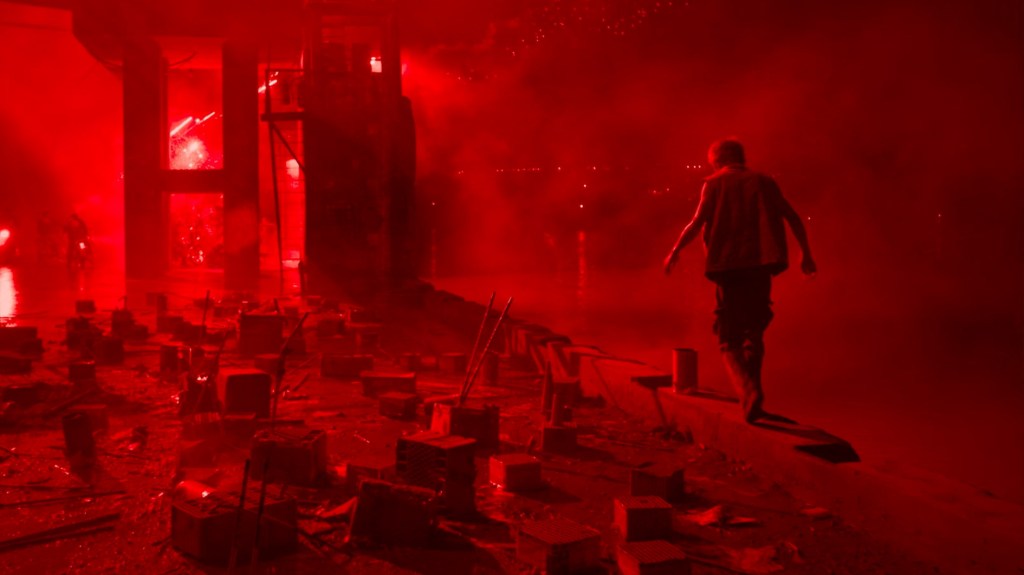
All of this is to say that the film does not have an overly wistful view of dreams. It does not present a world in which everything can be fixed just by dreaming. There’s an acknowledgement that dreams can actually hurt us or delude us or drive us around in circles. My favorite expression of this comes in the final epilogue dream where we see the deliriant and the woman from the silent film again. Now the dreamer’s body is covered in scars from injuries that we recognize. We have seen the dreamer sustain injuries in each of the dreams, but those are all presented as different characters in different worlds. But in this final dream, those scars are all attached to the dreamer. The idea being conveyed here is that we carry our dreams with us. Whether they propel us forward or pull us back, bring pain or pleasure, they are always there.
And this is what the film ultimately gets at. It is not that dreams (and by extension films) are these incredible things that need to be worshipped, but that they are something that we do have and that do affect us and that we should take seriously. In an interview with Film Comment, Bi Gan stated, “I imagined the very beginning of human civilization, without electricity and lights. There was day and there was night, and to compensate for the loss of vision at night, humans started dreaming. This now-useless ability follows us to the present day, but we’re becoming numb to it, and we’re even trying to control what we dream about. We want to control our illusions, our brains. What I want to say is that it’s okay not to control everything—it’s okay not to control our dreams.” In that context, the idea of dreams as some world saving rebellion seems actually anathema to the film. After all, in that final shot the world still burns. Dreams are not something we need to do. They are something we do. We will dream because that is what comes naturally to us. Maybe it actually is bad for us. Maybe we are burning our candles. Maybe our dreams can hurt us. But we accept that and croak in the dark because to desire something different is human. To deny ourselves of that or try to control it is to deny who we naturally are. Resurrection is not a film about dreaming. It’s a film about living.
I want to close with the end of the New Year’s Eve sequence. It is almost dawn and the man and the vampire find themselves back at the dock they met at earlier that night. The circular structure of the dreams seems to be repeating. They get on a boat that he knew would be there and start riding off somewhere. He says he wants to be with her, she tells him she’s a vampire, and he says he doesn’t care. She bites him on the neck. They make out and drive the boat out into the river. If vampire rules work like they do in the rest of fiction, they are both about to die as the sun comes up. But we don’t know if they do. The camera pans up and fades out to the final dream before that is resolved. We can assume the worst, and the sadness in how she speaks and moves around him makes it seem like she does too. But whether or not that does happen isn’t what matters. What matters is that they made a decision about what they wanted. They dreamed. That’s all they could do.
 Nonlinear Perspectives